Product Strategy
How to Reduce Bias in Product Decisions Using AI (2026 Guide)
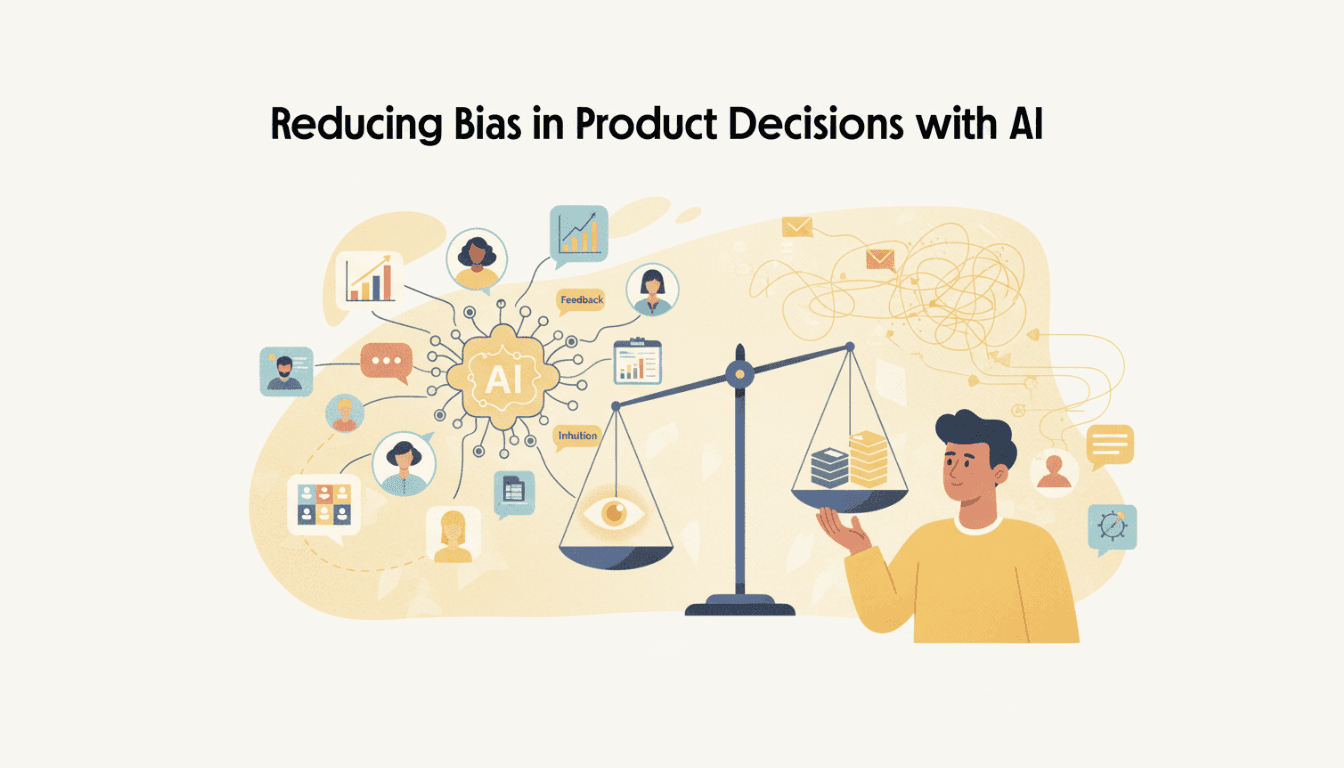
Product decisions are often influenced by opinions, incomplete data, and internal pressure, even in teams that consider themselves data-driven. Artificial intelligence (AI) helps reduce this bias by aggregating signals from multiple sources, identifying patterns at scale, and ranking opportunities based on measurable impact rather than intuition.
The objective is not to remove human judgment but to ground it in structured, consistent, and comprehensive data.
What Is Bias in Product Decisions?
Bias in product decisions happens when teams depend on subjective judgment instead of objective evidence to decide what to build. It usually appears in these situations:
A senior stakeholder pushes a feature based on a single customer conversation.
A recent complaint feels more important than long-term trends.
Teams favour ideas they already believe in and ignore conflicting evidence.
A few vocal users influence the product roadmap disproportionately.
Decision science research shows that humans naturally rely on heuristics and shortcuts when interpreting complex information. Without structured systems, bias is inevitable.
Why Bias Remains a Major Issue in 2026
It is reasonable to expect bias to decrease as teams gain more data. In reality, the opposite is true. Most product teams now experience the following challenges:
Feedback is distributed across tools like Slack, Notion, support platforms, and app reviews.
Analytics dashboards depend on manual interpretation.
Inputs from and customer success tools are rarely structured.
Teams work under constant pressure to move fast.
According to multiple industry reports, product managers spend a large portion of their time synthesizing information rather than making decisions. This leads to missed signals, decisions made with partial context, and a tendency to rely on intuition under time pressure.
The issue is no longer data scarcity. The real challenge is connecting that data into decisions that are clear, defensible, and repeatable.
How AI Reduces Bias in Product Decisions
AI shifts product decision-making from manual interpretation to structured analysis that can scale across data sources.
1. Aggregating Data Across Sources
AI systems can ingest and unify data from:
Customer feedback
Product analytics and usage patterns
Support tickets and conversation logs from tools such as zendesk and intercom.
CRM and sales interactions from platforms like hubspot and salesforce
By combining diverse datasets, decisions become more representative and reduce selection bias.
2. Clustering Feedback at Scale
One of the most common sources of bias is inconsistent interpretation of scattered feedback. AI can cluster similar feedback into meaningful groups. For instance:
Hundreds of onboarding-related complaints can be grouped into three to five major problem areas.
Feature requests with similar intent are unified under shared themes.
This makes decisions pattern-based rather than anecdote-based, reducing subjective distortion.
3. Applying Consistent Evaluation Criteria
Humans tend to evaluate opportunities inconsistently depending on context. AI adds structure by applying uniform evaluation criteria such as:
Customer impact
Revenue potential
Retention or churn influence
Effort required to implement
This ensures teams review ideas fairly and consistently.
4. Identifying Hidden Patterns
AI can find relationships across datasets that are hard to detect manually. For example:
A feature request might correlate with higher churn among a specific segment.
A usability issue might be linked to lower conversion rates.
These correlations reduce confirmation bias by surfacing insights that challenge assumptions.
5. Ranking Opportunities Based on Impact
AI can generate ranked lists of opportunities derived from consistent datasets. This shifts team discussions from “What should we build?” to “Why is this the highest-impact problem to solve?” It promotes evidence-based prioritisation over personal opinion.
Step-by-Step: How to Reduce Bias Using AI
Step 1: Consolidate Product Signals
Bring all relevant data into a centralised system, including:
User feedback from channels like Zendesk, Intercom, and Gong
Behavioural analytics from tools like Mixpanel, Amplitude, or Pendo
Business metrics such as revenue, churn, and retention
Fragmented data creates fragmented decisions.
Step 2: Create a Single Source of Truth
Connect your data from Slack, Notion, Atlassian tools (like Jira), and your analytics platforms.
Having a unified data hub ensures all stakeholders make decisions using consistent information.
Step 3: Define Clear Decision Criteria
Before introducing AI, define the evaluation framework. Decision criteria could include:
Potential impact on primary metrics
Alignment with company goals
Development effort and complexity
Without predetermined evaluation standards, even AI-generated recommendations can become inconsistent.
Step 4: Use AI to Structure and Analyse Data
Allow AI to manage:
Clustering of feedback
Pattern detection
Opportunity identification
This reduces manual effort and removes cognitive bias that often appears during manual synthesis.
Step 5: Prioritise Based on Structured Outputs
AI produces ranked opportunities along with clear reasoning.
This allows teams to justify decisions and explain prioritisation logic without relying on opinion.
Step 6: Validate with Strategic Context
AI improves decision quality, but human judgment is still required.
Teams should:
Review AI outputs
Apply business context
Align decisions with strategic priorities
Real Example
A product team receives hundreds of weekly signals across support channels, customer research, and analytics dashboards.
Without AI:
Product managers manually review feedback, which often leads to recent issues getting more attention than long-term patterns. Priorities shift frequently and important opportunities are missed.
With AI:
Feedback is automatically grouped into key problem areas
These clusters are linked to measurable business outcomes
Opportunities are ranked based on impact
The team focuses on a small number of high-impact priorities instead of reacting to scattered inputs.
Where Tools Like Squad AI and Others Fit
Solutions such as Squad AI, Aha!, Productboard, and Tability are designed to reduce bias by connecting signals and structuring product decisions.
These tools can:
Aggregate feedback from Slack, Notion, Intercom, and app store reviews
Automatically group similar feedback into insights
Map insights to strategic initiatives or measurable goals
Generate high-level, editable Product Requirements Documents (PRDs) quickly
Comparison: Traditional vs AI-Driven Product Decisions
Traditional Approach | AI-Driven Approach |
|---|---|
Opinion-based discussions | Data-backed prioritisation |
Manual review of feedback | Automated feedback clustering |
Inconsistent evaluation | Standardised scoring |
Static prioritisation cycles | Continuous updates |
Limited data sources | Multi-source signal integration |
Common Mistakes to Avoid
Using incomplete or biased datasets as input
Treating AI recommendations as final without review
Ignoring business goals while prioritising features
Over-relying on automation without understanding its logic
Defining unclear or shifting evaluation criteria
Key Takeaways
Bias in product decisions is unavoidable without structured systems
AI reduces bias by aggregating, clustering, and standardising inputs
Decision quality improves when teams apply clear criteria and high-quality data
AI supports human judgment rather than replacing it
The shift is from intuition-driven to system-driven decisions
FAQs
How do product managers reduce bias in decision-making?
They use structured frameworks, consolidate insights from multiple sources, and apply AI to identify patterns and prioritise opportunities objectively.
Can AI completely eliminate bias in product decisions?
No. AI reduces bias significantly, but human oversight is still required to ensure decisions align with strategy and context.
What types of bias affect product decisions?
Common types include confirmation bias, recency bias, authority bias, and selection bias. These often influence prioritisation and roadmap decisions.
How does AI contribute to product prioritisation?
AI clusters feedback, identifies patterns, and ranks opportunities based on criteria such as impact, effort, and alignment with business goals.
Which tools help reduce bias in product decisions?
Platforms such as Squad AI, Productboard, Aha!, and Tability help teams structure decision-making by connecting signals, clustering feedback, and linking opportunities to measurable outcomes.
Squad’s building towards a world in which anyone can develop and manage software, properly.
Join us in building user-centric products that deliver on your bottom line.