Product Strategy
Product Strategy vs Roadmap vs Vision for 2026.
What Each Means, Why Teams Confuse Them, and How to Get It Right
Key Takeaways
Most product teams struggle not because they lack effort, but because they lack clarity.
They jump into building features without clearly defining where they are going or why those features matter. This usually comes down to confusion between three core concepts: product vision, product strategy, and product roadmap.
Each plays a different role.
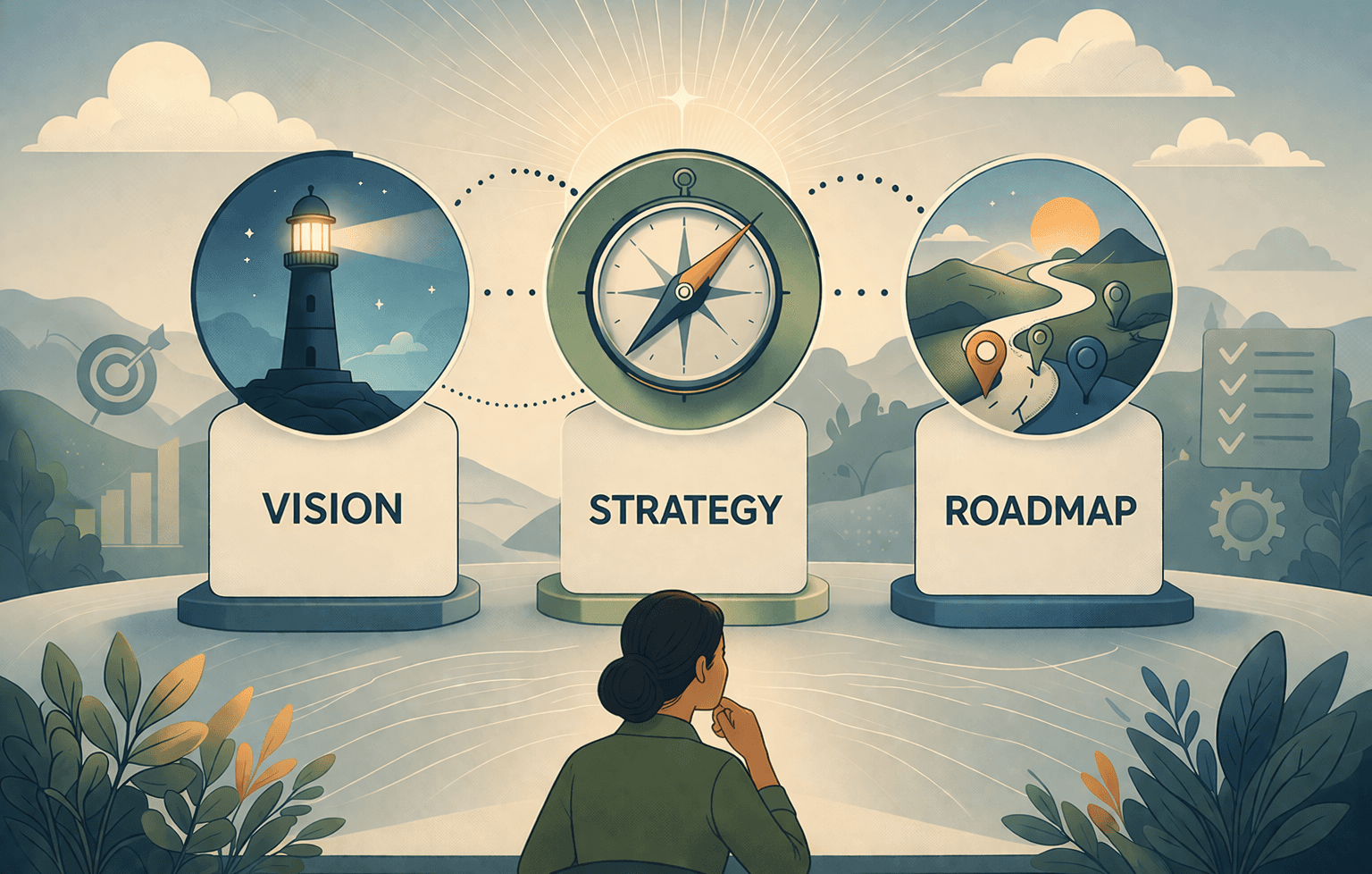
Product vision defines the long-term direction
Product strategy defines how you will get there
Product roadmap defines what you will build next
When these are clearly defined and connected, teams move faster and make better decisions. When they are not, teams end up reacting instead of building with intent.
Why This Confusion Happens
If you ask most product teams to explain their strategy, they will often show you a roadmap. If you ask them about their vision, you will likely hear something vague and aspirational that sounds good but does not actually guide decisions.
This confusion happens because roadmaps are visible and tangible, while strategy and vision require deeper thinking. It is easier to list features than it is to define trade-offs. Over time, teams begin to treat execution as strategy, focusing on what is being built without ever seriously asking whether those things should be built in the first place.
What is Product Vision
Product vision is the long-term direction of your product. It defines what you are trying to become and the impact you want to create over time.
A strong vision is simple, clear, and stable. It does not change every quarter, and it does not depend on specific features or releases. Instead, it acts as a guiding principle for all product decisions. A product vision might be something like "help product teams make better decisions faster." That does not tell you what to build next, but it gives everyone a clear sense of direction and a way to evaluate whether their work is aligned with the bigger goal.
What is Product Strategy
Product strategy sits between vision and execution. It defines how you plan to achieve your vision by making a set of deliberate choices, and a good strategy is not a list of ideas. It is a set of priorities and trade-offs.
It answers questions like: Which problems are we solving first? Which users are we focusing on? What are we deliberately not doing?
If your vision is to help teams make better decisions, your strategy might include focusing on reducing time spent analyzing feedback, prioritizing integrations with existing tools, and building systems that connect product signals in one place. This is where clarity begins to emerge. Strategy forces teams to say no to certain directions so they can focus on what actually matters.
What is a Product Roadmap
A product roadmap is where strategy turns into action. It outlines what the team plans to build and when, based on the priorities defined in the strategy.
Roadmaps are more detailed and more flexible than strategy. They change frequently as new data comes in, customer needs evolve, or priorities shift. A roadmap might include building a feedback aggregation system, launching a prioritisation engine, or improving collaboration workflows. These are concrete steps, but they only make sense when they are tied back to the strategy behind them.
A Simple Way to Think About It
One way to understand the difference is to think in terms of layers. Vision defines where you are going. Strategy defines how you will get there. Roadmap defines what you will do next.
When teams skip one of these layers, problems tend to show up quickly and in ways that are hard to diagnose because the issue is upstream, not in the execution itself.
Where Most Teams Go Wrong
The most common mistake is jumping straight to the roadmap. Teams start planning features without a clearly defined strategy, and without real alignment on vision. As a result, priorities shift frequently and decisions feel reactive rather than intentional.
Another common issue is treating the roadmap as the strategy itself. Teams assume that because they have a list of features and timelines, they have a strategy. In reality, they only have a plan for execution. Without strategy sitting behind it, even a well-executed roadmap can lead to completely the wrong outcomes.
How These Three Layers Should Work Together
The relationship between vision, strategy, and roadmap should be clear and sequential. The vision sets the direction. The strategy defines the key bets and priorities needed to move in that direction. The roadmap translates those priorities into specific initiatives and timelines.
To make it concrete:
Vision: Help teams make faster and better product decisions.
Strategy: Reduce time spent on manual analysis and improve visibility of product signals.
Roadmap:
Build automated feedback analysis
Integrate with Slack and CRM tools
Create prioritization workflows
Each layer builds on the previous one, which is what ensures that execution stays aligned with intent rather than drifting toward whatever feels urgent this week.
The Role of AI in This Shift
AI is changing how these layers connect, and it is solving a problem that has always existed but was harder to name.
Traditional tools often treat vision, strategy, and roadmap as separate artifacts. Documents live in one place, feedback in another, and roadmaps somewhere else. This creates gaps that teams fill manually, usually inconsistently.
Modern AI-powered tools are starting to bridge those gaps by connecting inputs, decisions, and outputs in one system. Customer feedback can be analyzed and grouped automatically. Insights can be linked to strategic themes. Priorities can be updated as new data comes in rather than waiting for the next planning cycle.
Tools like Squad AI focus specifically on this connection layer. Rather than just helping teams write documents or manage roadmaps, they help teams move from signals to decisions to execution in a more continuous way. Other tools also play important roles: Productboard helps organize and prioritize customer feedback, Aha provides structured roadmapping and planning, Jira Product Discovery connects ideas to delivery workflows, and Notion AI supports flexible documentation and drafting.
Each solves part of the problem. The difference comes down to whether a tool helps connect the full flow or just one layer of it.
What Strong Product Teams Do Differently
Strong product teams do not treat vision, strategy, and roadmap as separate exercises that happen at different times of the year. They make sure every roadmap item connects back to a clear strategy, and every strategy ties back to a defined vision.
They also treat all three as living systems rather than fixed documents. Vision evolves slowly. Strategy evolves based on what the team is learning. Roadmap evolves continuously. This allows teams to stay aligned while still being genuinely flexible when things change.
How to Get This Right
If you want to improve how your team works, start by asking a few honest questions. Can your team clearly explain the product vision? Do you have a written strategy with clear trade-offs? Can every roadmap item be linked back to that strategy?
If the answer to any of those is no, that is where the problem is, and that is where to focus before adding more tools or process on top.
The practical steps are not complicated: simplify your vision until it is actually memorable, make your strategy explicit so trade-offs are visible, keep your roadmap flexible enough to respond to new information, and make sure all three layers are connected rather than living in separate documents nobody updates.
Frequently Asked Questions
What is the difference between product strategy and roadmap?
Product strategy defines what you should focus on and why, while the roadmap defines what you will actually build and when. Strategy is about deliberate choices and trade-offs. The roadmap is how you execute on them.
Can a roadmap exist without strategy?
Technically yes, but it tends to lead to poor decisions because there is no clear reasoning behind the priorities. You end up with a plan that nobody can fully explain or defend when circumstances change.
How often should strategy change?
Strategy should evolve as you learn more about your users, market, and what is working. But it should not change as frequently as the roadmap. If your strategy is shifting every month, that is usually a sign that the vision is not clear enough.
Which tools help with product strategy?
Tools like Squad AI, Productboard, and Zeda.io help teams connect feedback, insights, and priorities more effectively. The best choice depends on where your current process is breaking down.
Final Thoughts
Most product teams are not struggling because they lack ideas or execution capability. They are struggling because the connection between their work and a larger direction is not clear enough to guide decisions day to day.
When product vision, product strategy, and product roadmap are clearly defined and genuinely connected, teams move faster, make better decisions, and build products that actually matter to the people using them. The goal is not to build more. It is to build the right things, for the right reasons, with enough clarity that everyone on the team knows the difference.
Squad’s building towards a world in which anyone can develop and manage software, properly.
Join us in building user-centric products that deliver on your bottom line.