Product Roadmapping
Top 10 AI-Powered PRD Generators to Accelerate Product Development in 2026
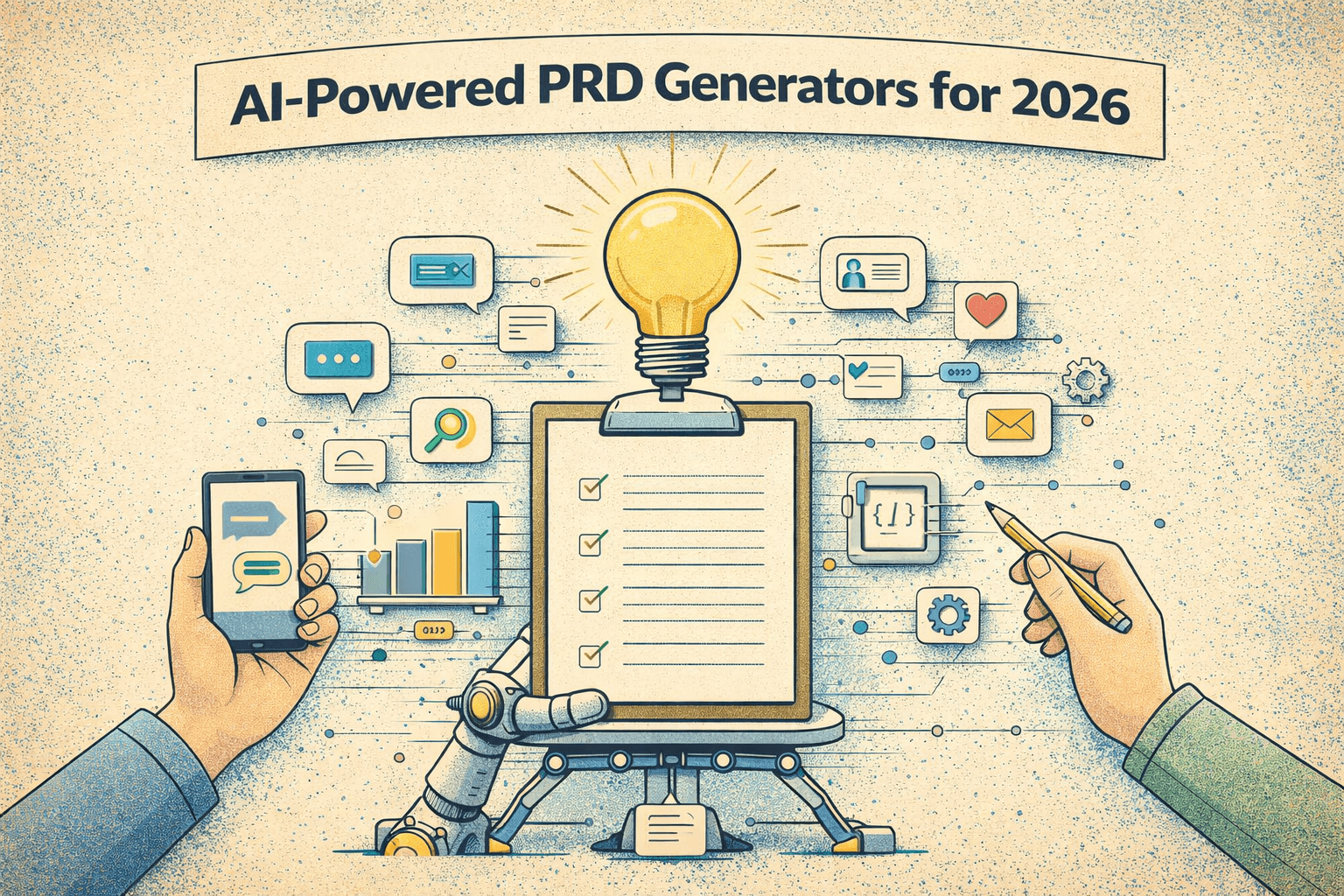
A comprehensive list of the best AI tools for creating Product Requirements Documents, featuring the latest innovations and integrations released this year.
The Shift Towards AI-Driven Product Documentation
Product development cycles are moving faster than ever, and the way teams write Product Requirements Documents (PRDs) is changing with them. What used to take days (the stakeholder alignment, the synthesis, the back-and-forth) can now get done in a fraction of the time using AI-powered tools.
But this isn't just a speed story.
It reflects something more fundamental about how product teams work today. The problem isn't a lack of data anymore. It's too much of it. Customer feedback, usage analytics, support tickets, Slack threads: there's no shortage of signal. The hard part is connecting all of it into a clear product direction.
AI PRD generators take on exactly that problem. They turn fragmented inputs into structured, actionable documentation, so product managers can spend less time synthesising and more time actually deciding.
What is an AI-PRD Generator?
An AI PRD generator is a tool that uses artificial intelligence to help you build Product Requirements Documents. Feed it a product idea, user feedback, or a set of business goals, and it turns that into structured outputs like:
Problem statements.
User personas and use cases.
Feature requirements.
Acceptance criteria.
Success metrics.
More advanced platforms go further, integrating directly with your product tools and data sources so PRDs get built from real-world signals, not just whatever you typed into a prompt box.
The Role of AI in Modern PRD Creation
AI is turning PRDs from static documents into something more like living systems.
Instead of writing from scratch every time, product managers can now:
Get a solid first draft in minutes.
Update requirements as new data comes in.
Give cross-functional teams a single source of truth.
Cut down on the ambiguity that slows decisions down.
The shift isn't about replacing the thinking. It's about removing the parts that get in the way of it.
Top 10 AI-Powered PRD Generators in 2026
1. Squad AI
Best for: End-to-end product strategy and PRD generation.
Squad AI was built around a specific problem: product teams don't struggle to write PRDs, they struggle to know what should go in them.
Rather than just responding to prompts, Squad pulls from customer feedback, product analytics, and business objectives to build a picture of what actually matters. From there, it generates structured outputs like prioritised roadmaps, PRDs, and execution-ready tasks, all grounded in real signals rather than assumptions.
Key Use Cases:
Converting customer feedback into structured requirements.
Aligning product strategy with execution.
Reducing manual effort in decision-making workflows.
Why it stands out:
Squad works upstream of the document itself. It focuses on product clarity first, so by the time a PRD gets written, the thinking behind it is already solid.
2. Figma AI PRD Generator
Best for: Visual-first product specification.
Figma's AI features let teams build PRDs right alongside their design work. Pairing structured documentation with visual prototyping makes it much easier to understand how a feature is actually supposed to behave, not just what it's supposed to do.
Key Use Cases:
UX-driven feature planning.
Visualising user journeys alongside requirements.
Enhancing cross-functional alignment.
3. Miro AI PRD Generator
Best for: Collaborative product planning.
If your team thinks on whiteboards, Miro turns that into structured documentation. It takes the output of brainstorming sessions and workshop discussions and organises them into something you can actually act on.
Key Use Cases:
Turning ideation sessions into actionable documents.
Facilitating team alignment.
Structuring unorganised inputs.
4. ChatPRD
Best for: Prompt-based PRD generation.
ChatPRD is the most direct route from idea to document. Type in what you're building and it generates a complete PRD in plain language. It's particularly useful during early-stage planning when you need to move fast and don't have much to start from.
Key Use Cases:
Rapid PRD creation.
MVP definition.
Solo product workflows.
5. Copilot for DevOps
Best for: Integration with engineering workflows.
This one lives inside the development environment and generates PRDs based on what's already in your backlog. Useful for teams where the line between product and engineering is blurry, or where it shouldn't be.
Key Use Cases:
Enterprise product environments.
Agile workflows.
Engineering-led organisations.
6. Beam AI
Best for: Automated documentation workflows.
Beam uses agent-based systems to take raw inputs like notes, research, and scattered ideas and structure them into proper PRDs. It's designed for teams that need documentation to happen continuously, not just at the start of a project.
Key Use Cases:
Large-scale product teams.
Automated knowledge workflows.
Continuous documentation.
7. Omniflow PRD Generator
Best for: Quick idea-to-PRD conversion.
Omniflow keeps it simple: put in a product idea, get a structured PRD out. No complex setup, no steep learning curve. Good for when you need something on paper quickly.
Key Use Cases:
Rapid prototyping.
Hackathons.
Early validation.
8. RapidNative PRD Generator
Best for: Lightweight PRD creation.
RapidNative is built for teams that don't want to think too hard about the tool itself. It strips away complexity and gives you a clean, quick way to draft PRDs without wrestling with integrations or setup.
Key Use Cases:
Quick drafts.
Early-stage teams.
Simple workflows.
9. QuillBot AI PRD Generator
Best for: Enhancing PRD clarity.
QuillBot focuses on the writing itself. Once you have a PRD, it helps you tighten the language, improve readability, and make sure the document actually communicates what you mean, not just what you wrote.
Key Use Cases:
Editing and rewriting PRDs.
Improving communication.
Structuring documentation.
10. BeeWeb AI PRD Generator
Best for: Voice-to-PRD workflows.
BeeWeb lets you speak your ideas and converts them into structured PRDs. Useful when you're moving fast, thinking out loud, or just don't want to sit down and type it all out.
Key Use Cases:
On-the-go ideation.
Brainstorming sessions.
Early-stage product thinking.
How to Choose the Right Tool
The right AI PRD generator depends on how your team actually works.
If you need speed and simplicity, a lightweight tool will get you there without much friction.
If collaboration and visualisation are central to your process, something like Miro or Figma is going to fit better.
If the goal is to make decisions rooted in real product signals rather than just prompts, a platform like Squad is built for that.
The Future of PRDs
PRDs are changing shape.
They're not single-moment documents anymore, written once, filed away, forgotten. The teams getting the most value out of them are treating them as living systems: updated as new information comes in, connected to the data that actually matters.
AI is what's making that possible. It handles the continuous updating, the cross-tool connections, the reduction of manual overhead, so the humans can focus on the decisions that require judgment.
The teams that win won't be the ones writing the most detailed PRDs. They'll be the ones who always know what needs to be built, and why.
Final Thoughts
AI-powered PRD generators are doing something more interesting than just writing documents faster. They're part of a broader shift toward product development that's more data-driven, more aligned, and less bottlenecked by documentation overhead.
At Squad, we think the future of product management is about connecting signals, keeping teams on the same page, and making it faster to go from insight to action. AI isn't just speeding up the paperwork. It's changing how products get built.
Squad’s building towards a world in which anyone can develop and manage software, properly.
Join us in building user-centric products that deliver on your bottom line.