Comparison
Best AI PRD Generators for Product Teams in 2026
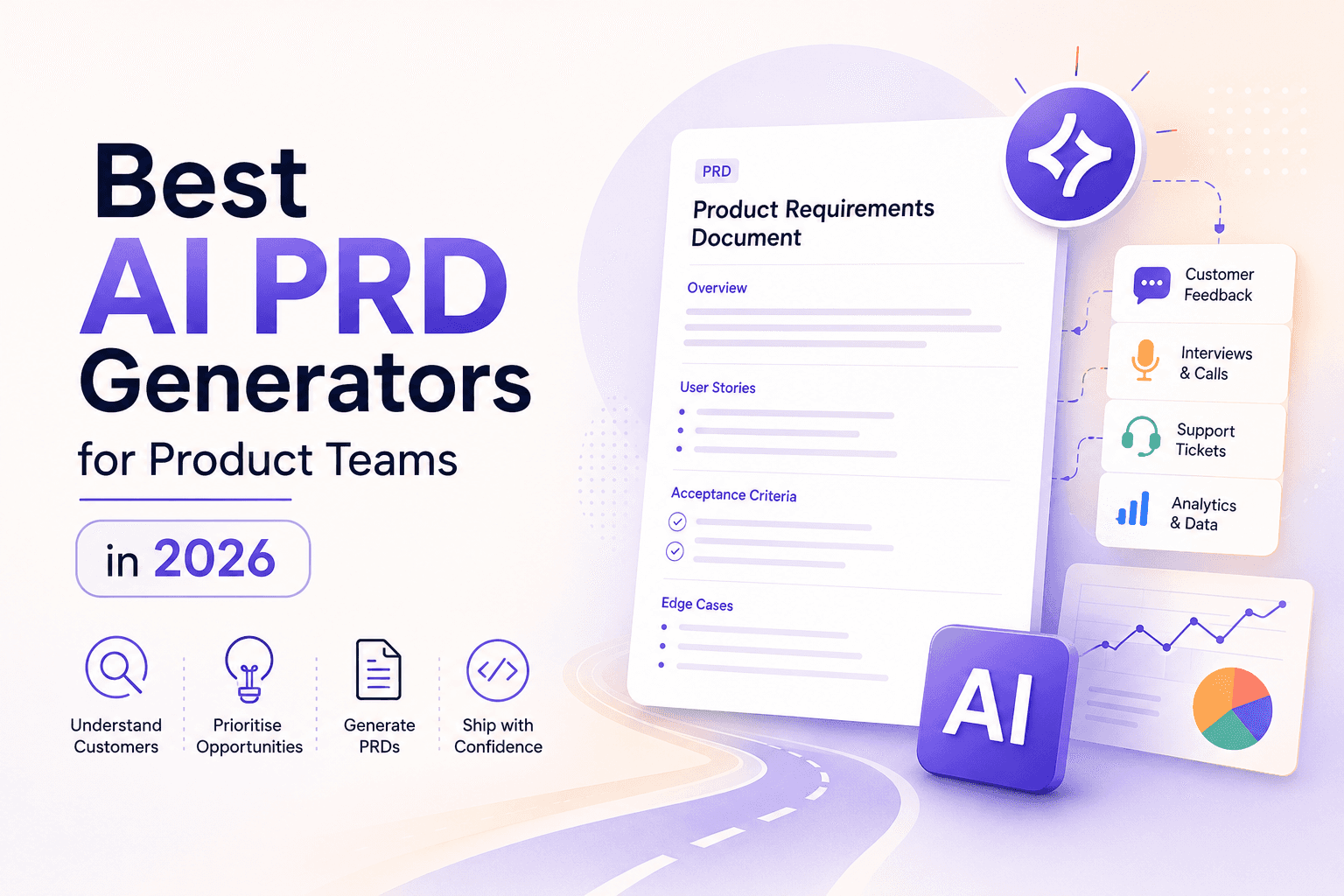
An AI PRD generator turns a rough product idea into a structured Product Requirements Document, complete with user stories, acceptance criteria, and edge cases, in minutes rather than hours. Product managers typically spend around six hours writing a single PRD by hand. Every tool below compresses that.
But the interesting question in 2026 is no longer whether AI can write a PRD. It obviously can. The question that actually separates these tools is harder, and most roundups skip it entirely.
The question that decides everything
Where does the tool get its facts?
Almost every AI PRD generator works from whatever you type into the prompt. Which means the quality of the document is capped by how well you can summarise your customers from memory. You are not eliminating guesswork. You are formatting it faster.
This matters because a well-written PRD for the wrong feature costs more than the tools that produced it. Reforge's 2026 Product Tooling Survey found that 67% of PMs say generic AI-generated PRDs need substantial rewriting before use, and the reason is rarely the prose. It is that the document was never grounded in anything.
So the tools below are split by that dividing line: those that write from your prompt, and those that write from your customer evidence. Both categories are legitimate. They just solve different problems, and knowing which one you have is the whole decision.
At a glance
Tool | Grounded in | Best for | Real pricing |
|---|---|---|---|
Your prompt | Solo PMs, conversational drafting | Free (3 docs), $8/mo Basic, $15/mo Pro, $29/seat Teams | |
Your prompt | Highest quality ceiling, PMs who write good prompts | Subscription | |
Your prompt and Notion docs | Teams already living in Notion | Add-on to Notion plan | |
Customer calls and tickets | B2B teams with heavy call volume | Paid plans | |
Connected customer signal | Teams who want the PRD to follow the evidence | Free Hobby, $12/mo Pro, $20/user/mo Team | |
Feedback tied to revenue | Larger orgs needing revenue-weighted specs | From ~$499/mo |
The prompt-grounded tools
These write from what you tell them. Fast, cheap, and genuinely useful when you already know what you are building.
ChatPRD
ChatPRD is the category's original and still its most popular. Built by Claire Vo, now used by more than 100,000 PMs. You chat your way to a PRD rather than filling in a template, and it will review an existing doc and tell you where the thinking is weak, which is the feature people actually stay for. Integrates with Linear, Notion, Slack, Confluence, Google Docs, and GitHub.
Real pricing: free tier capped at 3 documents. Basic $8/month for unlimited docs. Pro $15/month adds integrations and custom templates. Teams $29/seat/month for collaboration.
The honest limitation: it has no customer evidence layer. It cannot ingest call transcripts, support tickets, or Slack threads, so PRD quality is capped by how well you can recall what customers said. It also generates human-readable prose rather than agent-consumable specs, so it will not produce API schemas or agent config files.
Claude
Claude is the strongest general-purpose option, and worth taking seriously rather than dismissing as "just an LLM." In Aakash Gupta's independent head-to-head testing, well-prompted Claude matched ChatPRD's PRD quality (both graded B+) and scored higher on strategic thinking. The large context window swallows entire research reports and interview transcripts in one go.
The honest limitation: there is no "generate PRD" button, no guided interview, no document scoring. You are the prompt engineer, and quality varies between sessions if your prompting does. What you gain in ceiling you pay for in consistency.
Notion AI
Notion AI is convenient rather than specialised. If your team already documents everything in Notion, it summarises, structures, and drafts without adding another subscription or another tab.
The honest limitation: it is a capable general assistant, not a product tool. It will not surface edge cases you did not think of, and it does nothing to connect the document to customer reality.
The evidence-grounded tools
These write from what your customers actually said. Slower to set up, harder to fool.
BuildBetter
BuildBetter generates PRDs directly from customer calls, support tickets, and Slack threads, citing actual quotes and timestamps rather than paraphrasing from memory. If your team runs a lot of customer calls, this is the most direct answer to the evidence problem: the spec arrives with the receipts attached.
The honest limitation: its value scales with call volume. Teams without a steady stream of recorded customer conversations will not get much from it, and it is built around the call as the primary unit of evidence, so signal living in product analytics or support tickets carries less weight.
Squad AI
Squad AI approaches the PRD from the opposite end of the workflow. Rather than starting with your prompt, it starts with your customer signal, connecting the sources you already use, including Slack, Gong, Intercom, and PostHog. Its Insights agent surfaces which opportunities actually matter against your business goals, its Strategy agent compares competing solutions before you commit to one, and only then does its Planning agent write the PRD, with user stories, acceptance criteria, and QA test cases, pushing developer-ready tasks to Linear, Cursor, or GitHub.
The point is not that the writing is better. It is that the document carries a decision trail: what was decided, what was rejected, and why. When leadership challenges the spec three weeks later, the reasoning is still there. Squad AI was named in the Gartner May 2026 Market Guide for AI Product Management Platforms.
Real pricing: free Hobby plan, no card required. Pro $12/month. Team $20/user/month.
The honest limitation: this is more tool than you need if you just want a fast draft. Squad is a decision layer, so it wants connected data sources to be useful, and if you have no customer signal to connect, a prompt-based tool will get you a document faster.
Zeda.io
Zeda.io pulls feedback from Slack, sales calls, tickets, and CRMs, then maps the revenue weight of each request, so the PRD can be justified in financial terms.
The honest limitation: from around $499/month, it is significantly more expensive than everything above, and the setup work is real.
What AI still cannot do
Worth being blunt, because the tools will not tell you this.
AI drafts structure. It does not decide scope. It surfaces edge cases, and it will still miss the one that matters because it does not know your legacy billing system or the enterprise customer who will churn if you change the export format.
The consistent finding across independent testing is that AI eliminates the mechanical writing, which is the three or four hours of formatting and rewriting, and leaves the judgment untouched. Scope, trade-offs, stakeholder context, and knowing what not to build remain human. A PRD without evidence is a guess in document form, and a PRD without judgment is just a well-formatted one.
How to choose in 60 seconds
Ask yourself one question: do you already know what you are building?
If yes, you have a documentation problem. Buy the cheapest tool that drafts well. ChatPRD at $8 to $15 a month, or Claude if you write good prompts and want the higher ceiling. Do not overbuy.
If no, you have a decision problem wearing a documentation costume. A faster drafting tool will help you write the wrong spec more efficiently. You want something grounded in customer evidence: BuildBetter if you have call volume and need quotes with timestamps, Squad AI if the issue is deciding what deserves building and defending that decision later, Zeda if the argument you keep losing is about revenue.
Most teams who think they need a PRD generator are actually in the second category and do not realise it yet. That is worth ten minutes of honesty before you spend anything.
Frequently asked questions
What is the best AI PRD generator in 2026?
It depends on whether you already know what you are building. For fast drafting from a prompt, ChatPRD is the most popular dedicated tool at $8 to $15 per month, and Claude matches it on quality in independent testing if you are comfortable prompting. For PRDs grounded in real customer evidence rather than a PM's memory, BuildBetter and Squad AI connect to customer signal directly.
How much does ChatPRD cost?
ChatPRD's free tier is capped at 3 documents. Basic is $8 per month for unlimited documents, Pro is $15 per month and adds integrations and custom templates, and Teams is $29 per seat per month for collaboration features.
Is Claude as good as a dedicated AI PRD tool?
On output quality, yes. Independent head-to-head testing by Aakash Gupta graded well-prompted Claude and ChatPRD equally (both B+), with Claude scoring higher on strategic thinking. The difference is workflow, not quality: dedicated tools wrap PM best practices into the prompt automatically, whereas with Claude you supply the structure yourself.
Can AI write a complete PRD without human review?
No. Independent testing consistently finds that AI generates strong first drafts but cannot replace product judgment on scope, trade-offs, and stakeholder context. Reforge's 2026 survey found 67% of PMs say generic AI-generated PRDs require substantial rewriting. The reliable workflow is AI for speed, human for strategy.
What is the difference between a prompt-based and an evidence-based PRD generator?
A prompt-based generator, such as ChatPRD or Claude, writes from what you type, so document quality is capped by how well you can recall customer needs from memory. An evidence-based generator, such as BuildBetter or Squad AI, connects to customer calls, support tickets, and product signal, so the PRD is grounded in what customers actually said rather than what you remember them saying.
Do free AI PRD generators produce usable documents?
They produce usable first drafts. Free options include ChatPRD's 3-document tier and Squad AI's free Hobby plan. The limitation is rarely writing quality. It is that a free tool grounded in nothing still produces a well-formatted guess, which is the expensive failure mode.
What does PRD stand for?
PRD stands for Product Requirements Document. It explains what is being built, who it is for, why it matters, and what success looks like, typically including user stories, acceptance criteria, success metrics, and edge cases.
Pricing and benchmark data reflect publicly available information as of July 2026, drawn from each tool's own site and independent testing. Verify current pricing before purchase, since plans change.
Squad’s building towards a world in which anyone can develop and manage software, properly.
Join us in building user-centric products that deliver on your bottom line.