Product Strategy
Decision Intelligence: Why AI Tools can't tell you why you built something
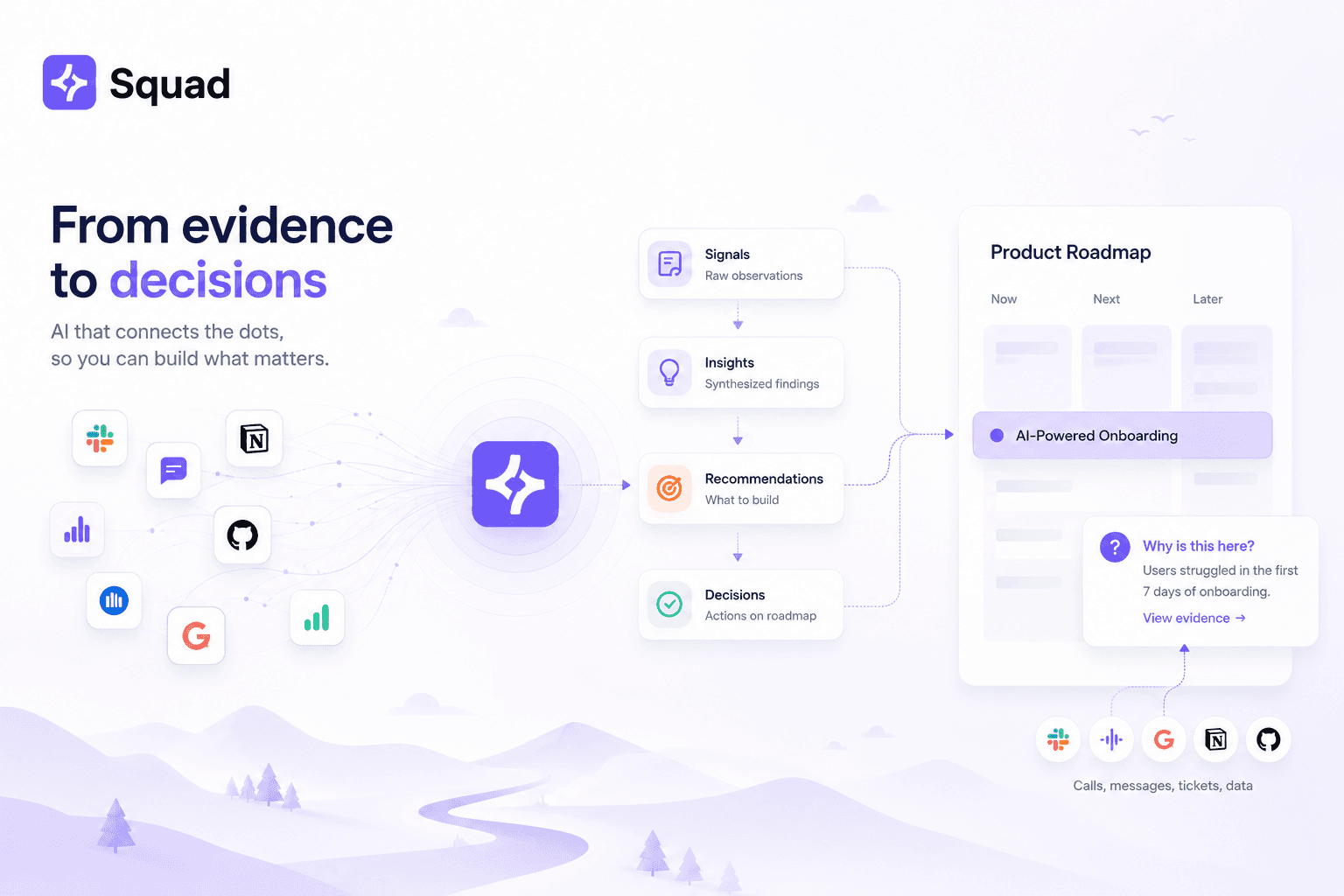
Every product tool ships a roadmap view. Almost none of them can tell you why anything is on it.
That gap has a name. Product roadmap traceability is the ability to take any item on your roadmap and follow it back to the real-world evidence that put it there. It's the visible symptom of a deeper problem: most AI tools for product managers manage outputs, not decisions. That's a consequence of how these systems are built.
Why AI product tools lose the trail
The dominant pattern in AI product tooling is request-scoped retrieval. A question comes in, the system reaches out to your connected sources, pulls back what's relevant, reasons over it, and returns an answer. The retrieved context lives for the duration of that request and then it's gone.
For a lookup, this is correct. It's stateless, cheap, scales well, and it's always current because it re-fetches every time. "What did customers say about onboarding last month" is a question this architecture answers well.
It's the wrong architecture for a decision, and the reason is subtle. A lookup asks the system to find something. A decision asks it to have been watching. Those are different jobs. The first needs retrieval. The second needs accumulation, and accumulation is the one thing a request-scoped system structurally cannot do. Every query starts from a blank slate and rebuilds the world from whatever it can reach in that moment.
A necessary caveat, because this is where the argument usually goes wrong. Modern assistants do have memory. They persist facts across sessions and will recall your Q3 goal. But session memory is a store of things you said, not a model of evidence that's been reasoned over. Recall retrieves a fact. Judgment notices that the fact you're about to act on contradicts something a customer told you in March. The first is a lookup with better ergonomics. The second requires a system that's been maintaining state the whole time.
What decision intelligence actually requires
If you want a system that can answer "why is this on the roadmap," you're not building retrieval. You're building an evidence store with an audit trail. Four design decisions fall out of that, and each one has a real cost.
Sources persist instead of being summarized at read-time
The obvious optimization is to summarize a source on ingest and discard the original. Cheaper, and the summary is what you'll reason over anyway.
We don't, because a summary can't be a citation endpoint. If someone challenges a recommendation and the trail terminates at "a summary of a call," you haven't proven anything. You've moved the trust problem one step down. The trail has to end at something a human can look at and verify. That means keeping the artifact, paying for storage, and handling more noise on ingest.
Observations are atomic and append-only
Signals are the individual observations extracted from a source. One complaint. One pricing change. One request. Each recorded once, never overwritten.
Append-only is the constraint that makes the audit trail real. The moment records can be mutated, "here's the evidence" becomes "here's the evidence as it currently appears," which is a very different claim. An audit trail you can quietly edit isn't one. The cost: you can never clean up. Corrections are new records, not edits, and you carry the full history forever.
Findings grow instead of regenerating
This is the load-bearing decision, and the least obvious.
The easy implementation synthesizes findings on demand. Ask what customers think about onboarding, cluster the relevant signals fresh, and return a result. Simpler, always current.
It's also a snapshot with no history. It can't tell you this pattern has been strengthening for three quarters, or that it appeared, got addressed in March, and came back. It has no memory of having existed before, so it can't reason about its own trajectory. Every answer is confident and contextless.
A finding that persists and absorbs new signals over time is a different object. It has a lifespan. It strengthens. It can be contradicted. It distinguishes a blip from a trend, which is the whole difference between noise and a reason to build something.
The cost is real: persistent findings can drift. As evidence accumulates, an insight can slowly become something its original signals don't support. That's a genuine hazard, and it's exactly why the citation chain matters. Drift is detectable when every finding still points at the specific evidence underneath it. Regenerated snapshots can't drift, but only because they have no past to drift from. We took the harder problem deliberately.
Everything cites upward
A recommendation cites its insights. Insights cite their signals. Signals cite their source. Follow the chain and you land on the hard evidence.
The constraint: synthesis can never lose provenance. Every step that combines or condenses carries its references forward, which rules out a lot of convenient shortcuts. It's also what turns output from a claim into confidence.
The product context layer that results
These four constraints produce a specific shape. Squad is a product context layer, not a chatbot with tools attached. The tool call is step one, not the job.
The pipeline:
Data: sources captured and kept. Live today: Slack, Notion, Gong, GitHub, Linear, PostHog, and app stores and review sites.
Knowledge and Signals: Knowledge is the current state of the world, editable markdown with full version history, so you can see who changed what and whether it was a person or the system. Signals are the append-only observations.
Insights: synthesized findings that cite their source signals and grow as new evidence arrives. The compounding layer.
Actions: recommendations with status and priority.
One-Pagers: PRDs and decision docs generated from actions, citing the insights and transitively the signals behind them.
Agents run on schedules or react to events, so a new call landing or a competitor page changing feeds the pipeline without anyone remembering to check.
The result: every recommendation is traceable. Follow anything back through insights, to signals, to the actual call or message it came from.
Context engineering, and what it's for
The vocabulary catching on for this is context engineering: the discipline of getting the right durable context in front of a model rather than optimizing the prompt in front of it. That's the mechanism. Decision intelligence is what it's for.
Product data isn't scarce. Feedback, sales calls, support tickets, analytics, and research all exist. They're just scattered across a dozen tools with nobody assembling them, so decisions get made on gut feel and whoever argued loudest.
Decision intelligence is the layer that closes that gap. Not another dashboard telling you what happened, but a system that holds the reasoning itself: what you decided, on what evidence, and whether that evidence still holds up today. Context engineering is how you feed it. Traceability is what it looks like from the outside.
Confidence isn't one good answer. It's evidence that stacks up over time. A system that treats every fetch as disposable can never stack anything.
The honest summary
None of this is exotic. There's no clever trick. It's the boring, expensive version: keep the artifacts, never mutate the record, let findings accumulate instead of regenerating them, and refuse to break the citation chain even when it'd be convenient.
Most tools don't do this because request-scoped retrieval is far easier to build and it demos beautifully. It only fails at the one moment that matters, six months later, when someone asks why you built the thing.
The tool call is step one. What you do with what comes back is the product. That's the difference between a tool that answers questions and a system that holds decisions.
Squad’s building towards a world in which anyone can develop and manage software, properly.
Join us in building user-centric products that deliver on your bottom line.